Before I level the camper, before I unhook the truck, before the slides come out, and before Dawn starts making the inside look like home, I do one thing first:
I test the electrical pedestal.
Every single time.
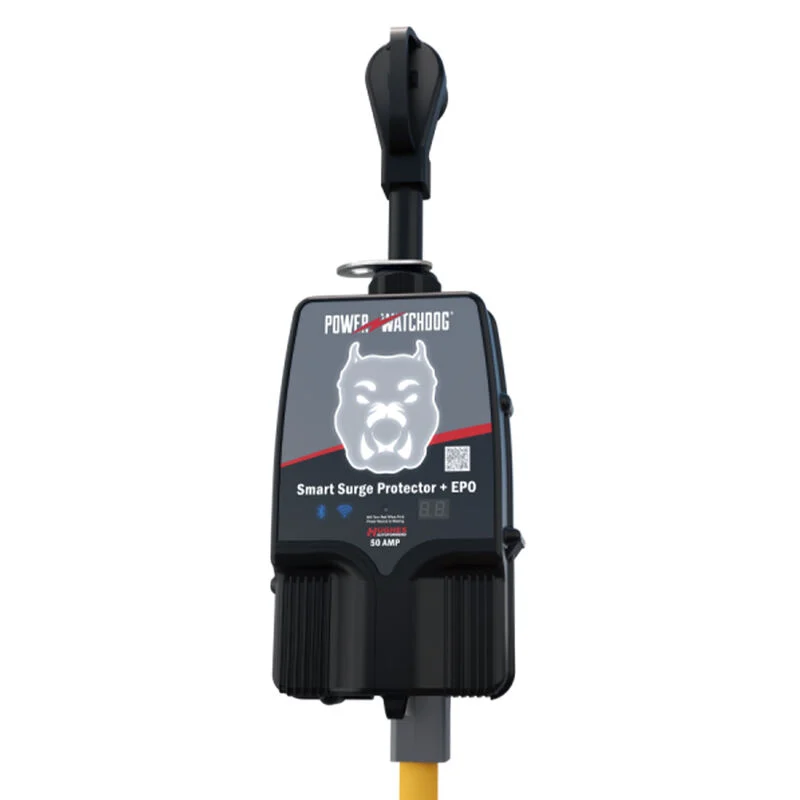
I plug our Hughes Power Watchdog 50-Amp EPO into the campground pedestal and make sure everything is doing what it is supposed to do before we commit to the site.
Why?
Because I have absolutely no desire to spend 20 or 30 minutes getting our fifth wheel backed in, leveled, unhooked, slides out, chairs unloaded and everything set up—only to discover that the electrical pedestal has a problem.
At that point you get to reverse the entire process and possibly move to another site.
That sounds like a wonderful way to begin a camping trip.
And by wonderful, I mean I would probably invent several new words that Dawn would prefer I not use in public.
So electrical power gets checked first.
Always.
And the piece of equipment we trust to do that job is our Hughes Power Watchdog 50-Amp EPO with Bluetooth.
We also added a locking security cable because the Watchdog’s job is to protect our camper—not wander off in the middle of the night and start protecting somebody else’s.
After using it, this has become one of those pieces of RV equipment that I wouldn’t camp without.
First, What Exactly Is the EPO Version?
There are several versions of the Hughes Power Watchdog, and this distinction is important.
Ours is the 50-amp EPO model.
EPO stands for Emergency Power Off.
That means our Watchdog doesn’t simply tell us there is a problem.
If incoming voltage becomes dangerously low or dangerously high, the EPO can actually disconnect power to the RV.
According to Hughes, the unit shuts power off if voltage drops to 104 volts or below or rises to 132 volts or above.
Once conditions return to an acceptable level, the Watchdog waits before restoring power. The unit has a 90-second delay, which is particularly important for things like air-conditioning compressors.
That is one of the biggest reasons we bought the EPO version.
There is a huge difference between something saying:
“Hey Mark, you’ve got a problem.”
And something saying:
“Hey Mark, you’ve got a problem, so I already shut the power off before you could make it worse.”
I prefer the second one.
Why I Test the Pedestal Before Setting Up
This is worth repeating because I see people do the opposite all the time.
They pull into the campsite.
Back in.
Level.
Unhook.
Put down the stabilizers.
Open the slides.
Get out the chairs.
Hook up the sewer.
Hook up the water.
Then, somewhere around step 47, they finally plug into electricity.
I don’t understand that.
Before our truck gets disconnected from the camper, I want to know that the site is usable.
I plug the Watchdog directly into the pedestal and let it check the campground power.
If something isn’t right, I haven’t really lost anything.
The truck is still attached.
The camper isn’t completely set up.
We can contact the campground, have the pedestal checked or move to another site.
That five-minute habit could save a tremendous amount of aggravation.
I’ve learned over the years that there are plenty of opportunities in RVing to make life unnecessarily difficult.
I don’t need to create additional ones myself.
Why Does an RV Need This Much Electrical Protection?
If you are new to RVing, spending several hundred dollars on something that sits between your power cord and a campground electrical box may seem excessive.
I understand that.
I thought the same thing when I first started looking at them.
Then I started thinking about what is inside a modern RV.
We have:
- Air conditioners
- Refrigerator
- Microwave
- Converter/charger
- Television
- Fireplace
- Control boards
- Charging equipment
- Electronics
- USB systems
- And more electrical gadgets than campers had in an entire campground 30 years ago
Now start adding up what it would cost to repair or replace some of that equipment.
Suddenly that expensive Watchdog starts looking considerably cheaper.
Our fifth wheel represents a substantial investment.
Trying to save a couple hundred dollars on the device standing between all of that equipment and an unknown campground electrical pedestal didn’t make much sense to us.
The Campground Pedestal Is the Wild Card
Here is something every RVer eventually discovers.
Campground electrical systems are not all created equal.
We’ve stayed at campgrounds with beautiful, modern electrical pedestals that look like they were installed yesterday.
And we’ve seen others where I’m pretty sure Thomas Edison personally signed off on the installation.
Campgrounds also put their electrical systems through a lot.
Think about how many campers plug and unplug from a popular site during a season.
Connections wear.
Receptacles loosen.
Equipment ages.
Weather gets to things.
Campgrounds expand.
Electrical demand changes.
And when everyone in the campground decides to run their air conditioners on a hot summer afternoon, the electrical system can be working pretty hard.
None of that automatically means the campground has done anything wrong.
It simply means I’m not plugging our camper directly into an unknown power source without something between us and it.
Trust—but verify.
That rule works pretty well with electricity.
The 50-Amp EPO Doesn’t Just Watch—It Can Disconnect Us
This is probably the biggest reason I recommend the EPO version.
The Watchdog continuously monitors incoming electrical power.
If the voltage goes outside its safe operating limits, it can disconnect the camper from shore power.
That is important because both high and low voltage can be bad news for RV electrical equipment.
Most people naturally think about a big electrical surge.
Lightning.
Power spike.
Something dramatic.
But low voltage can also be a serious problem, particularly for equipment such as air conditioners.
That’s where having an actual power-management system rather than just basic surge protection starts making sense.
I don’t want to have to be sitting inside watching the voltage every second.
That’s the Watchdog’s job.
I paid him.
He can take the night shift.
4,900 Joules of Surge Protection
The 50-amp EPO model is rated for 4,900 joules of surge protection.
I’m not going to pretend that Dawn and I sat around the kitchen table discussing joules before we bought it.
We didn’t.
I’m also not going to turn this review into an electrical engineering class.
The important part for us was simple:
The Watchdog provides substantial surge protection between the campground pedestal and our fifth wheel.
Hopefully, it never has to sacrifice itself protecting our camper from a major electrical event.
But that’s exactly what we bought it for.
It’s a little like carrying a fire extinguisher.
If I own it for 20 years and never use it, I’m not going to complain that I wasted my money.
I’ll consider that a very successful purchase.
One of My Favorite Features: The Surge Module Is Replaceable
This is something Hughes got right.
Surge protection components don’t necessarily last forever.
Every time they absorb a significant surge, they can lose some of their ability to handle another one.
With many surge protectors, once the protection is used up, you’re buying another complete unit.
Not necessarily with the Watchdog.
The surge module in our 50-amp EPO is replaceable.
So if the surge protection eventually does its job and reaches the end of its useful life, we don’t necessarily throw the entire Watchdog in the trash.
We replace the surge module.
I really like that design.
If the Watchdog ever takes one for the team and saves the fifth wheel, I’ll gladly buy him a replacement module.
I may even hold a small memorial service for the old one.
“Here lies Surge Module Number One. He gave his life protecting two air conditioners, a refrigerator and a microwave.”
Semper Fi.
Bluetooth Sounded Like a Gimmick—Until We Started Using It
When we bought ours, we decided to get Bluetooth.
I’ll admit that when I first looked at it, Bluetooth fell into the category of:
“That’s kind of neat.”
Now I wouldn’t buy one without it.
The Power Watchdog connects to an app on your phone and lets you monitor what’s happening with your electrical system.
You can see information such as incoming voltage, amperage and power consumption.
And this becomes slightly addictive.
Turn on the first air conditioner.
Check the phone.
Turn on the second air conditioner.
Check the phone.
Start the microwave.
Check the phone.
Pretty soon Dawn is looking at me like I’ve been appointed Director of the North American Electrical Grid.
But beyond the novelty, it is genuinely useful.
You start understanding how your camper uses electricity.
More importantly, you can see what kind of power the campground is actually delivering.
I like information.
I’d rather know what’s happening than assume everything is okay because the television hasn’t caught fire.
Monitoring Both Sides of a 50-Amp RV Connection
A 50-amp RV electrical service isn’t simply a bigger version of a 30-amp plug.
A 50-amp RV connection has two hot legs.
That gives a 50-amp RV considerably more available power than a 30-amp RV connection.
The Watchdog monitors what is happening with that electrical supply and gives us visibility into what our camper is receiving.
That becomes particularly useful when we’re using multiple high-draw appliances.
Air conditioners are running.
Microwave comes on.
Water heater may be operating.
Other equipment is running in the background.
Instead of guessing, I can look.
Maybe that appeals to the technology side of me.
Or maybe I’m just getting older and have reached the point where staring at voltage readings qualifies as entertainment.
Either way, I like it.
The 90-Second Restart Delay Is Important
If the Watchdog detects a problem and cuts power, it doesn’t immediately slam everything back on the instant voltage looks acceptable again.
There is a 90-second restart delay.
That’s there for a reason.
Air-conditioning compressors don’t particularly enjoy rapid off-and-on power cycles.
Giving equipment time before power is restored provides additional protection.
It is another one of those features you may never really notice.
And that’s fine.
The best safety equipment usually isn’t exciting.
It just quietly does its job.
It Also Checks for Wiring Problems
Another reason I plug the Watchdog into the pedestal before setting up is that it can detect electrical conditions you don’t want feeding your RV.
The unit provides error codes for various incoming-power problems.
So I don’t have to look at a campground electrical box and think:
“Well, it looks okay.”
Electricity has this irritating habit of being completely invisible.
A pedestal can look perfectly fine from the outside and still have an electrical issue.
That’s why I want the Watchdog involved before our fifth wheel is.
Then There Is the Famous Watchdog Face
Hughes could have put a few boring indicator lights on the front of the unit.
Instead they gave us the glowing Watchdog face.
I’ll admit it.
I like it.
It also makes checking things at the pedestal pretty straightforward.
When I initially plug in, I’m looking at the Watchdog before our camper gets connected.
If he’s happy, I’m happy.
If he’s not happy, we’re not plugging the fifth wheel into that pedestal until we figure out why.
Simple.
The Locking Cable Was a No-Brainer
There is one obvious downside to buying a nice portable electrical-management system.
It’s portable.
Unfortunately, that means it is portable for everybody.
Your expensive Watchdog is hanging outside the camper, usually right beside the road or campsite where anyone walking by can see it.
Security is one of those things we have gradually upgraded around the camper. We also replaced our factory entry lock with the Bauer NE Bluetooth Keyless Entry, which has turned out to be another RV upgrade we would buy again.
So we added a locking security cable.
Is a steel cable going to stop someone who arrives with bolt cutters and is absolutely determined to steal our Watchdog?
Probably not.
Locks rarely stop a determined thief.
What they do is stop—or at least discourage—the opportunistic thief.
Without a lock:
Unplug it.
Grab it.
Leave.
With the cable installed:
Now somebody has to stand beside our campsite fooling around with a locked cable attached to an expensive piece of electrical equipment.
That’s a much less attractive proposition.
For what the Watchdog costs, adding a locking cable just makes sense.
Apparently, buying protection for your protection is another one of those wonderful parts of RV ownership.
Our Normal Setup Routine
Our electrical setup now looks something like this.
We pull into the site and get positioned where we think we want the fifth wheel.
Before doing the complete setup, I go to the pedestal.
I inspect it.
I plug in the Watchdog.
I let the Watchdog evaluate the electrical supply.
If everything checks out, then we know we can continue setting up.
Only after I’m comfortable with the power do we proceed with everything else.
Then the camper gets plugged into the Watchdog, the security cable gets attached and we’re ready to go.
It has become second nature.
The whole process takes only a few minutes.
Compared with completely breaking camp because the pedestal isn’t working correctly, those few minutes are nothing.
What Happens If the Campground Power Goes Bad Later?
This is another reason the EPO version makes sense.
Electrical conditions can change.
A pedestal can test perfectly when you arrive at 2:00 in the afternoon.
That doesn’t mean voltage can’t change later when every camper in the park returns, starts dinner and turns on every electrical appliance they own.
That’s when I want the EPO watching things.
We don’t have to sit there staring at a meter.
The system monitors the electrical supply.
If voltage goes outside its protection limits, it can remove power from our RV.
Once acceptable power returns, the delay gives the system time before restoring electricity.
That is exactly the type of protection I wanted.
Check it when we arrive.
Continue watching it after I’m done.
What I Like About the Hughes Power Watchdog
The EPO Protection
This was the big one for us.
I want more than a device that simply tells me something went wrong.
I like that the EPO can disconnect our RV when incoming voltage becomes unsafe.
Bluetooth Monitoring
I thought it would be a nice extra.
It turned out to be one of my favorite features.
Being able to sit inside the camper and check incoming voltage and electrical usage from my phone is extremely useful.
Replaceable Surge Module
This makes a lot of sense.
If the surge protection reaches the end of its useful life, you can replace the surge module instead of automatically replacing the entire Watchdog.
4,900-Joule Surge Protection
That’s substantial protection standing between an unknown campground pedestal and a very expensive fifth wheel.
90-Second Restart Delay
Especially valuable for protecting equipment such as air-conditioning compressors following an interruption.
Pedestal Diagnostics
This is why the Watchdog comes out before we ever finish setting up.
I want to know the pedestal is okay first.
Easy to Use
For everything the unit is doing in the background, using it is remarkably simple.
Plug it in.
Let it check the power.
Connect the camper.
The Security Cable
I sleep better knowing somebody can’t simply unplug our Watchdog and walk off with it.
What Don’t I Like?
Nothing is perfect.
It Is Expensive
There is no way around that one.
This isn’t a $39 RV accessory.
When you start shopping for the 50-amp EPO model, you may experience what I call RV Accessory Sticker Shock Syndrome.
Symptoms include staring at the price for several minutes, asking your spouse “How much?” and convincing yourself that maybe the $29 version from somewhere on the Internet is probably good enough.
Then I remember what the fifth wheel cost.
And what two air conditioners cost.
And an RV refrigerator.
And control boards.
And electrical repairs.
The Watchdog suddenly doesn’t seem quite as expensive.
It’s Another Thing Hanging Outside
That’s the downside of a portable unit.
It has to go outside at the pedestal.
That’s why we use the security cable.
It’s Another Piece of Equipment to Remember
You have to hook it up when you arrive and take it with you when you leave.
But if remembering the Watchdog is one of the biggest problems I have during a camping trip, we’re having a pretty good trip.
Is It Overkill?
Someone will inevitably say:
“I’ve been camping for 30 years and I’ve never used one.”
Fair enough.
People drove for decades without seat belts too.
That doesn’t make a seat belt a bad idea.
Risk is funny that way.
You can get away with something hundreds of times.
Then number 101 gets expensive.
Our approach is pretty simple.
We have too much invested in our fifth wheel to depend entirely on every campground pedestal we encounter being perfect.
Maybe we’ll own the Watchdog for years and never experience the electrical event that would have damaged our camper.
I sincerely hope so.
That doesn’t mean buying it was a waste.
It means we got exactly the camping experience we wanted.
Uneventful electricity.
Is the Bluetooth Version Worth the Extra Money?
For us, yes.
Without hesitation.
If all I wanted was something sitting outside providing protection, I could live without Bluetooth.
But once you’ve been able to see your incoming voltage and electrical consumption from inside the camper, it is difficult to go backward.
It also helps you learn your RV.
You begin seeing the effect different appliances have on your power consumption.
I consider that useful information.
Dawn may consider it another excuse for me to stare at numbers on my phone.
Both things can be true.
Is the EPO Version Worth the Extra Money?
This is the easier question.
Yes.
For me, the EPO is the entire point.
I don’t just want notification that campground voltage has reached a potentially dangerous level.
I want the system capable of doing something about it.
If we’re asleep, away from the campground, sitting around a campfire or just not looking at the phone, the Watchdog doesn’t need us hovering over it.
That’s what we paid it to do.
Would We Buy the Locking Cable Again?
Absolutely.
We’re already protecting an expensive camper with an expensive electrical protection system.
Spending a little more to make the electrical protection system harder to steal seems like common sense.
I don’t expect the cable to defeat someone from Mission Impossible.
I’m trying to discourage the guy who thinks:
“Hey, nobody’s looking.”
Keep walking.
This dog is on a leash.
Is the Hughes Power Watchdog 50-Amp EPO Worth the Money?
For us, absolutely.
And I don’t say that about every RV accessory we’ve bought.
We’ve purchased a few things over the years that seemed like fantastic ideas at the time and later joined that special collection of camping equipment known as:
“Why in the world did we buy this?”
The Power Watchdog isn’t one of them.
It gets used every single time we camp.
Not occasionally.
Not when we remember.
Every time.
Before I completely set up the fifth wheel, I test the pedestal.
Once everything checks out, the Watchdog stays connected for the duration of our stay and continues monitoring the electrical supply.
That’s real value to me.
Final Verdict
The Hughes Power Watchdog 50-Amp EPO is not a glamorous RV accessory.
Nobody is going to walk through the campground and say:
“Wow, look at that surge protector!”
At least I hope not.
But some of the best RV purchases aren’t glamorous.
They’re the things quietly doing their jobs in the background.
Our Watchdog protects against electrical surges.
It monitors campground power.
It watches voltage.
The EPO can disconnect our fifth wheel if voltage becomes unsafe.
Bluetooth lets me monitor what’s happening from my phone.
Its replaceable surge module means the entire unit doesn’t necessarily become disposable after the surge protection has done its job.
And our security cable gives it a fighting chance of still belonging to us the next morning.
That’s a lot of protection from one ugly little box hanging from a power pedestal.
Our Rating: 5 out of 5
Would we buy it again? Absolutely.
Would we buy the 50-amp EPO version again? Without question.
Would we pay extra for Bluetooth again? Yes.
Would we buy the security cable again? Definitely.
Do I test the pedestal before setting up the fifth wheel? Every single time.
For me, that last part may be the biggest lesson of the entire review.
Don’t completely set up your camper and then find out whether the campsite has usable electricity.
Test first. Set up second.
Five minutes at the electrical pedestal can save you 30 minutes of colorful language while you hook the fifth wheel back to the truck.
The Watchdog isn’t one of the cheapest pieces of equipment we carry.
But compared with what it’s standing there protecting?
I think it’s money very well spent.
And hopefully our Watchdog spends its entire life hanging quietly from campground pedestals without ever having to prove just how valuable it really is.
Leave a Reply