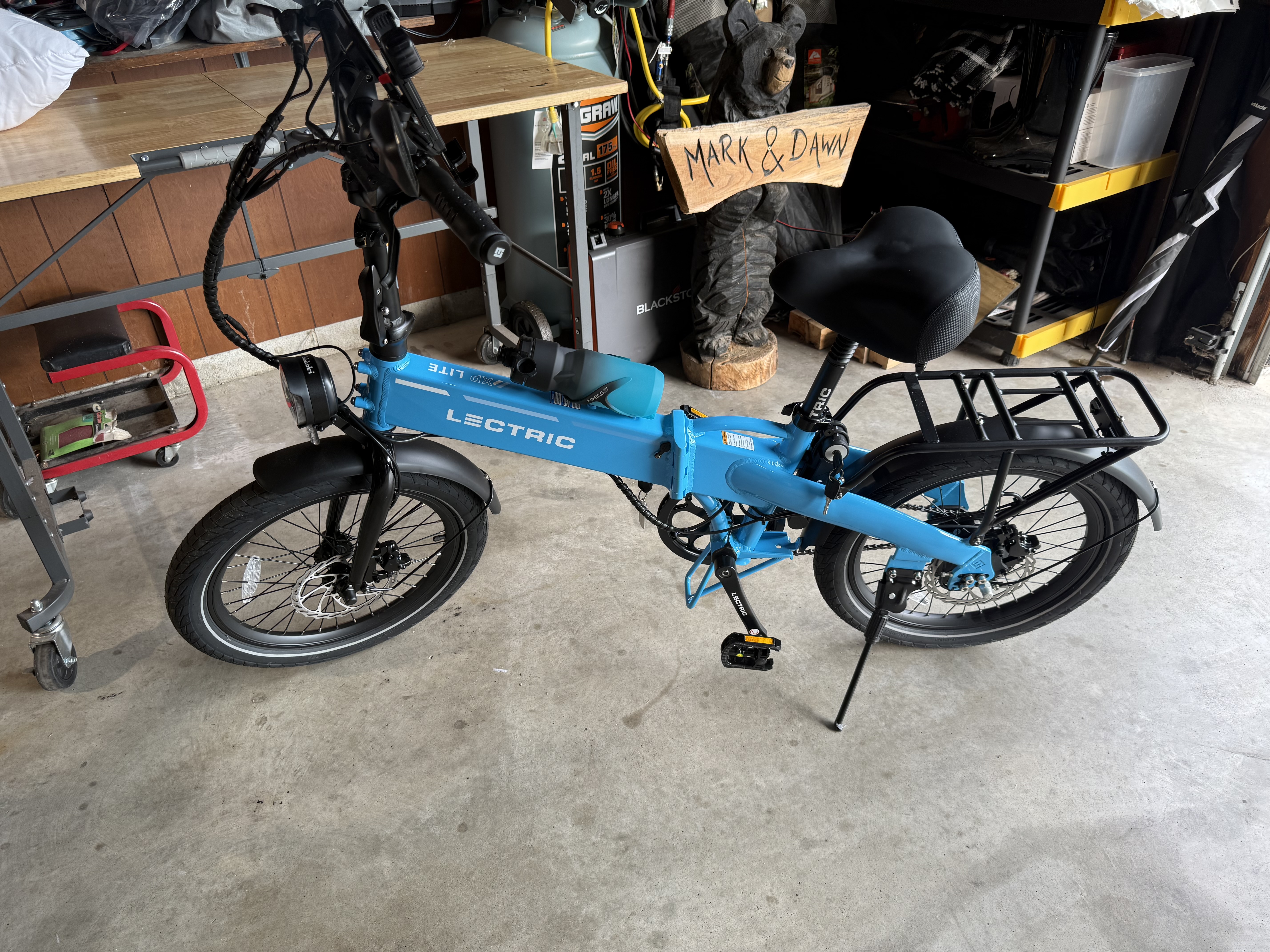
When Dawn and I decided we wanted e-bikes for camping, I made the mistake I usually make whenever we buy something new.
I started researching.
And researching.
And researching some more.
Apparently, simply walking into a store, pointing at something and saying, “We’ll take two of those,” isn’t how my brain works.
We wanted bikes we could ride around campgrounds, take on paved bike trails, use to explore nearby towns and generally give us another way to see things without firing up the truck every time we wanted to go a few miles.
But we also had another problem.
Whatever we bought had to travel with a fifth wheel.
That immediately made size and weight almost as important as speed, range and comfort.
After looking at a lot of different e-bikes and talking with several people who already owned them, we eventually settled on two Lectric XP Lite 2.0s.
Dawn chose blue.
I chose white.
Because apparently even after almost 35 years of marriage, matching bicycles would have been going too far.
We upgraded both bikes to the long-range batteries.
Now that we’ve owned them for a while and actually put some miles on them, I think we’re in a much better position to answer the question we couldn’t answer when we first bought them:
Did we make the right choice?
For the way we camp and ride, I think we did.
But they aren’t the right e-bike for everybody.
Why We Chose the XP Lite 2.0
Our priorities were pretty simple.
We wanted something:
• Relatively lightweight
• Foldable
• Easy to transport with the camper
• Comfortable for recreational riding
• Capable of handling paved trails and campground roads
• With enough battery range that we weren’t constantly watching the gauge
• Fast enough to be fun without convincing two people in their 60s that they were suddenly competing in the Tour de France
The XP Lite 2.0 checked most of those boxes.
Lectric currently lists the bike at about 49 pounds with the battery installed and about 41 pounds with the battery removed.
That was a big deal to us.
There are plenty of e-bikes on the market weighing 60, 70 or even 80 pounds.
That may not sound like a huge difference until you’re standing behind your camper trying to lift one onto a bike rack.
Then suddenly every pound matters.
We always remove our batteries before transporting the bikes, which gets each bike down to roughly 41 pounds.
That makes them considerably easier to handle and also means the expensive lithium batteries aren’t bouncing around on the back of the fifth wheel for hundreds of miles.
Our XP Lite 2.0 Setup
We purchased the long-range version.
Lectric lists the long-range battery at 672 watt-hours and advertises up to 80 miles of range.
Let me emphasize two very important words there:
Up to.
I haven’t ridden one 80 miles, and I have absolutely no intention of telling you that you’ll get 80 miles simply because that’s the number printed on the website.
E-bike range depends on rider weight, speed, hills, wind, temperature, tire pressure, how much pedal assist you use and probably whether Mercury is in retrograde.
Okay, maybe not that last one.
For the kind of riding Dawn and I actually do—campgrounds and mostly paved bike trails for a few hours at a time—the long-range batteries give us considerably more capacity than we normally need.
And that’s exactly how I like it.
I’d rather come home with plenty of battery remaining than spend the last five miles calculating whether I’m going to have to pedal a 49-pound bicycle back to the truck with no assistance.
Motor and Speed
The XP Lite 2.0 uses a 300-watt rear hub motor with a listed peak output of 819 watts and 28 Nm of torque.
Top speed is 20 mph.
For us, 20 mph is plenty.
Actually, 20 mph on a bicycle feels considerably faster than 20 mph sounds while you’re sitting in a chair reading about it.
At this point in my life, I have no desire to conduct an experiment to determine exactly how far a 66-year-old former Marine will slide across pavement after leaving a bicycle at 20 mph.
Some questions are better left unanswered.
The bike has five levels of pedal assist along with a twist throttle.
When I first rode Dawn’s bike, I started in PAS 0 with no motor assistance and then moved up through the different levels.
What impressed me immediately was how smoothly the assistance came in.
It didn’t feel like the bike was trying to jerk itself out from underneath me.
You pedal, the motor recognizes what you’re doing, and the assistance comes in naturally.
That’s important for someone who hasn’t ridden bicycles regularly in years.
What Pedal Assist Is Actually Like
This is one of those features that makes much more sense after you ride an e-bike.
Pedal assist does not mean you push a button and pretend to pedal while the bicycle does everything.
You’re still riding a bicycle.
The difference is that it feels like someone suddenly made your legs considerably stronger.
On lower settings, you still do a fair amount of work.
Move up through the assist levels and hills get easier, acceleration gets easier and maintaining speed requires less effort.
The throttle is also handy when starting from a stop or when you just want a quick burst of assistance.
For recreational trail riding, I don’t feel any need to run around at maximum assist all the time.
Part of the reason we bought bicycles was to get some exercise.
If I wanted to sit on something and twist a throttle the entire time, I’d buy another motorcycle.
The Brakes Are Excellent
One of the upgrades on the XP Lite 2.0 is hydraulic disc brakes with 180mm rotors.
This is one feature I appreciate more now than I did when we bought the bikes.
The brakes have a very good feel.
You don’t have to squeeze the levers like you’re trying to crush walnuts to get the bike stopped.
They respond smoothly and provide plenty of stopping power.
That’s especially important on an e-bike because you’re carrying more weight and potentially traveling faster than you would on a conventional bicycle.
They don’t feel grabby, but when you tell the bike to stop, it stops.
That’s exactly what I want.
The Color Display

I also really like the color LCD display.
It gives you your speed, battery information, pedal-assist level, mileage and the other basic information you actually need while riding.
It’s bright, easy to read and doesn’t require you to scroll through seventeen menus to figure out how fast you’re going.
There is also a USB-A port, which could be handy for a phone or other device.
As someone who spent a good portion of his life working with computers, I appreciate technology.
I just don’t need my bicycle dashboard to resemble the cockpit of an F-35.
Lectric got this one about right.
Comfort After Longer Rides
This was something we really couldn’t judge when I wrote my original review.
A five-minute ride around the neighborhood doesn’t tell you much about comfort.
After spending more time on them, I’d call the XP Lite 2.0 comfortable for the type of recreational riding we do.
The seat and handlebars have enough adjustment to get the riding position where you want it.
That said, no bicycle is automatically going to fit every rider perfectly.
After longer rides, I’ve noticed some tingling in my wrists and hands. That’s something I’m working on through riding position and handlebar/grip adjustments rather than something I would automatically blame on the bike.
If you haven’t ridden regularly in years, don’t assume every ache after your first two-hour ride means something is wrong with the bicycle.
Sometimes the problem is the part sitting on the seat.
The 20-Inch Tires
The XP Lite 2.0 uses 20 x 2.5-inch tires.
For what we bought these bikes to do, I like them.
They’re well suited to pavement, campground roads and the paved bike trails we’re most interested in riding.
These aren’t fat-tire off-road bikes, and that’s fine with us.
If your idea of riding involves deep sand, mud, serious mountain-bike trails or beating your way through the woods, this probably isn’t the bike I’d choose.
Our idea is more along the lines of:
“There’s a nice paved trail. Where does it go?”
That’s where these bikes make sense.
Folding: Useful, But Don’t Expect a Briefcase
One of the biggest reasons we originally looked at the XP Lite 2.0 was because it folds.
The folded dimensions are roughly 36 inches long, 16 inches wide and 27 inches high.
That gives you more transportation options than a full-size rigid e-bike.
But let’s clear something up.
“Folding bicycle” does not mean you fold it up, tuck it under your arm and stroll through the airport like you’re carrying a laptop bag.
It’s still a bicycle.
And it still weighs around 49 pounds with the battery.
The folding feature is useful because it reduces the overall footprint and makes storage easier.
It does not magically turn an e-bike into carry-on luggage.
Battery Removal: One Little Lesson We Learned
We remove both batteries whenever we’re hauling the bikes.
At first, removing one of the batteries seemed harder than it should have been.
We eventually discovered that the rubber plug around the charging-port area could interfere enough to make things more difficult.
Once we figured that out, battery removal became much easier.
That’s one of those little things you only learn after actually living with a product.
The batteries themselves slide into the frame, which keeps the bike looking clean and keeps the battery protected.
We transport the batteries separately rather than leaving them installed while the bikes are riding on the rear rack.
One Thing I Still Don’t Like: The Key
This was my complaint in the original review, and it remains my complaint.
The key has to stay in the bike while it is turned on.
And the key location underneath the frame isn’t exactly what I would call convenient.
Is it a deal breaker?
No.
Is it something I would change if Lectric asked me?
Absolutely.
I’d much rather turn the bike on, remove the key and stick it in my pocket.
It’s a small complaint, but good reviews should tell you what someone doesn’t like—not just spend 2,000 words explaining why everything they bought is wonderful.
Then Come the Accessories…
Nobody warned me that buying the bicycles was apparently just the admission price.
Then you start thinking:
We need helmets.
We need mirrors.
We need locks.
We probably need bags.
A phone holder might be useful.
Maybe some tools.
A tire pump.
What about…
Stop.
At some point you’re going to realize you’ve purchased enough bicycle accessories to open a small sporting-goods store.
Some accessories have been genuinely useful, but I recommend riding the bikes first before buying every item somebody on YouTube says you “absolutely must have.”
Use the bike.
Figure out what bothers you.
Then fix that problem.
Transporting Them With Our Fifth Wheel
This became a project all by itself.
We eventually purchased the Hollywood Racks RV Rider HR1700 to carry the two Lectrics.

The relatively low weight of the XP Lite 2.0 was another advantage here.
With the batteries removed, we’re carrying roughly 41 pounds per bike instead of two 70- or 80-pound e-bikes.
That makes loading easier and reduces the amount of weight hanging off the rear of the fifth wheel.
We’ve since learned there is a lot more to safely carrying e-bikes behind a fifth wheel than simply adding up the weight of the bikes and looking at the receiver rating.
I cover all of that—including something important we discovered about our own receiver—in our Hollywood RV Rider HR1700 review.
If you’re planning to carry e-bikes behind a fifth wheel, I’d strongly recommend reading that before buying a rack.
What We Like Most About the XP Lite 2.0
The biggest thing is probably how approachable these bikes are.
Neither Dawn nor I needed a high-performance mountain bike.
We weren’t looking for something capable of doing 35 mph.
We wanted bicycles we could get on, enjoy and use to explore places while camping.
The XP Lite 2.0 does that extremely well.
They’re light enough for us to handle.
They’re easy to ride.
The motor assistance is smooth.
The hydraulic brakes are excellent.
The batteries offer far more range than we normally need.
And the folding design gives us additional storage and transportation options.
Most importantly, we actually enjoy riding them.
A bicycle can have the greatest specifications in the world, but if it sits at the campground because you don’t enjoy riding it, you bought the wrong bicycle.
What We Don’t Like
No product is perfect.
My biggest complaints are:
• The key location underneath the bike is awkward
• The key has to remain in the bike while you’re riding
• At 49 pounds, “Lite” is relative—it’s light for an e-bike, not light compared with a normal bicycle
• Folding and unfolding takes a little practice
• The slick 20 x 2.5-inch tires make much more sense for pavement than serious off-road riding
• Riders planning steep hills, rough terrain or heavy cargo may want a more powerful model
• Like every e-bike, accessories can quickly turn a reasonable purchase into a small financial event
None of those would stop me from buying the bikes again.
Pros
• Relatively lightweight for an e-bike
• About 41 pounds with the battery removed
• Folds for easier transportation and storage
• 20 mph top speed is plenty for recreational riding
• Smooth pedal-assist system
• Five pedal-assist levels
• Twist throttle
• Excellent hydraulic disc brakes
• Bright, easy-to-read color display
• Long-range battery option
• Up to 80 miles of advertised range with the long-range battery under ideal conditions
• Comfortable for campground and paved-trail riding
• Easy initial assembly
• Adjustable seat and handlebars
• Easy for someone returning to cycling after many years
• Fun—which is ultimately the whole point
Cons
• Awkward key location
• Key remains inserted while operating the bike
• Still fairly heavy compared with a conventional bicycle
• Not what I would choose for serious off-road riding
• Published maximum range shouldn’t be confused with guaranteed real-world range
• Accessories can add up quickly
Who I Think These Bikes Are For
I think the XP Lite 2.0 makes a lot of sense for RVers.
Especially couples like us who want to explore campgrounds, paved trails and nearby towns without carrying two extremely heavy full-size e-bikes.
I also think it’s a good option for someone getting back into cycling after being away from it for years.
The pedal assist lets you determine how much work you want to do.
Feeling good?
Turn the assistance down and pedal.
Meet a hill that looked considerably smaller from 200 yards away?
That’s why there’s a motor.
Who Should Look at Something Else?
If you regularly ride serious off-road trails, I’d look at something with more aggressive tires and suspension.
If you’re dealing with very steep terrain all the time, you may want a more powerful motor with considerably more torque.
If you’re hauling heavy cargo or need a utility bike, Lectric makes models better suited to that job.
And if you want something that goes 30-plus mph, the XP Lite 2.0 isn’t your bike.
For us, none of those things matter.
We weren’t looking for an electric motorcycle pretending to be a bicycle.
We wanted camping bikes.
Would We Buy Them Again?
Yes.
Knowing what I know now, I’d still buy the Lectric XP Lite 2.0.
I’d still get the long-range batteries.
And I’d still choose the lighter bikes over some of the much heavier alternatives we considered.
They fit the way Dawn and I actually camp.
That’s the important part.
There are faster e-bikes.
There are more powerful e-bikes.
There are bikes with bigger tires, suspension and enough accessories to look like they belong on a military convoy.
But those features also bring more weight, more size and usually more money.
The XP Lite 2.0 gives us what we actually need without a lot of things we don’t.
Our Verdict
Ease of riding: 9/10
Weight and portability: 9/10 for an e-bike
Brakes: 9/10
Comfort: 8/10
Battery capacity: 9/10
RV/camping usefulness: 9.5/10
Key location: 5/10 — Lectric, we need to talk
Overall: 9/10
When I wrote our original article, we’d barely gotten the bikes out of the boxes and I ended it by asking:
Two new e-bikes, a campground full of trails, and two people who haven’t ridden bicycles regularly in years.
What could possibly go wrong?
A few weeks later, I’m happy to report that nothing major has gone wrong.
We’ve spent money on accessories.
I’ve learned more about bike racks than any sane person should know.
We’ve discovered a few little things we’d change.
And we’ve found another way to enjoy camping together.
I’d call that money well spent.
Now I’m still not completely ruling out getting Odie his own trailer.
But knowing him, he’ll insist on padded seating, climate control, snack service and a written guarantee that lunch will be served at exactly noon..
Leave a Reply